 VapeWholesaleHub
Nicotine Supplier Scorecard Template — Cross-Border Trade
Retailers rarely lose money on nicotine because of price. They lose money because the first container was bought on a photograph. This page walks through what actually matters when you source nicotine at scale, written from the buying desk rather than the marketing department.

Inspection Before Dispatch
Most defects in nicotine are not dramatic. They are loose tolerances, a slightly thin seal, a mouthpiece that clicks. Left alone they turn into leak complaints, which are the single most common reason a retailer drops a line.
- Confirm the current customs classification with your own broker.
- Rotate stock by batch code rather than by delivery date.
- Model landed cost, not ex-works price, when comparing quotes.
- Start with a mixed carton and let your own sell-through decide.
- Ask how the factory measures puff count, then compare like with like.
How Nicotine Fits the Assortment
One useful exercise: list every nicotine line you stock and mark the last date each one sold at full price. Anything without a recent full price sale is taking space from something that would use it better.
Think about where nicotine sits in your customer's week. If it is a weekly restock, breadth matters less than availability. If it is an occasional treat, flavour range and display story carry more weight.
Trends Worth Watching
Retailers report that nicotine customers are asking more specific questions than they did two years ago. That favours ranges with clear, simple information over ranges with clever marketing.
Getting Nicotine to Your Warehouse
Freight is the hidden half of nicotine unit economics. A denser master carton can save more per unit than a hard negotiation on factory price, because the saving repeats on every reorder rather than once.
Track nicotine landed cost per unit as a running number, including duty and local delivery. It is the only figure that tells you whether a supplier change actually improved anything.
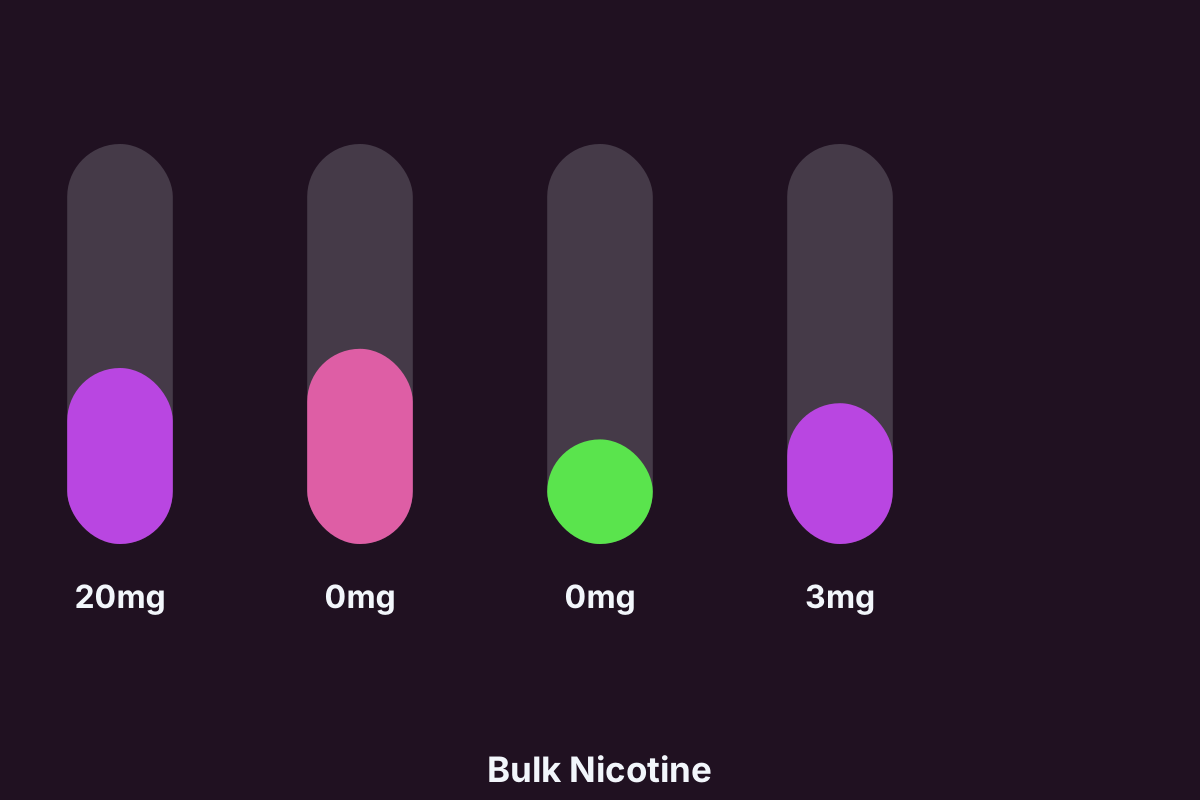
What Nicotine Really Costs Landed
Hold a small nicotine buffer in your pricing model for currency movement. A few percent on a container is a real number, and it is easier to plan for than to absorb.
Indicative reference points for planning purposes: entry tier from USD 2.20 per unit at 1000 units, mid tier at USD 1.24, and volume tier at USD 1.12 for full container quantities. These figures move with specification, packaging and freight, so treat them as a shape rather than a quote.
Practical Checklist
- Agree the tolerance band in writing before approving artwork.
- Model landed cost, not ex-works price, when comparing quotes.
- Start with a mixed carton and let your own sell-through decide.
- Keep sealed retained samples from every production batch.
- Write the complaint threshold into the order terms.
- Ask how the factory measures puff count, then compare like with like.
Frequently Asked Questions
What is the usual minimum order for nicotine?
For a standard production run the minimum is normally one master carton per flavour, though mixed cartons can be arranged for a first order. If you are testing the line, ask about a sample pack first and treat the freight as part of your research budget.
Is there support for in-store material?
Yes. Shelf talkers, counter cards and simple planogram suggestions are available for nicotine ranges that reach a sensible volume. Most retailers find the plain strength and flavour cards do the most work.
What if I only need a small first order?
That is normal and sensible. A mixed carton lets you test nicotine in your own market before committing to a production run, and the specification you approve at that stage carries through to larger orders unchanged.
Is there a warranty on nicotine?
Manufacturing defects are covered against the retained sample standard. Normal wear, misuse and damage after opening are not. We publish the threshold in the order terms so both sides know exactly what the claim process looks like.
Do you provide compliance documents?
Every shipment leaves with the documentation set relevant to your market, including batch records and test reports where required. Your local rules still determine what you must file, so confirm those with your broker before import.
Next Step
Questions that are not answered here are usually the interesting ones. Reach out with the specifics of your market and we will answer with numbers rather than adjectives.
Related Reading
- Nicotine Last Mile Delivery for Local Retailers — New Distributors
- How to Brief a Factory on Nicotine — Entry-Level Price Points
- Nicotine OEM and ODM: Which Model Fits Your Business — Replenishment Cycles
- Nicotine Display Ideas for Small Counters — Small Batch Buyers
- Nicotine Growing From Pallet to Container — Regional Distributors
- Nicotine Shelf Rotation for Multi Site Retailers — Latin America